
- Equity is commonly known as shares and stocks.
- It is something that every trader is familiar with.
- But equity can be both positive as well as negative.
What is negative equity?
- Equity in the stock market or the shareholder’s equity will refer to the monetary value of a company after deducting its liabilities from its total assets.
- Shareholder’s equity is considered the total worth of the company, and this will also determine the ability of the company to pay back the traders who have bought the securities in the company.
- Negative equity will occur when the liabilities of the company are greater than its total assets.
- It will mean that even if all of the assets of the company were to be liquidated, there might not be enough funds left to pay back the traders.
Reasons for negative equity
- There are several reasons for negative equity.
- Here, we will discuss 4 main reasons for such negative equity.
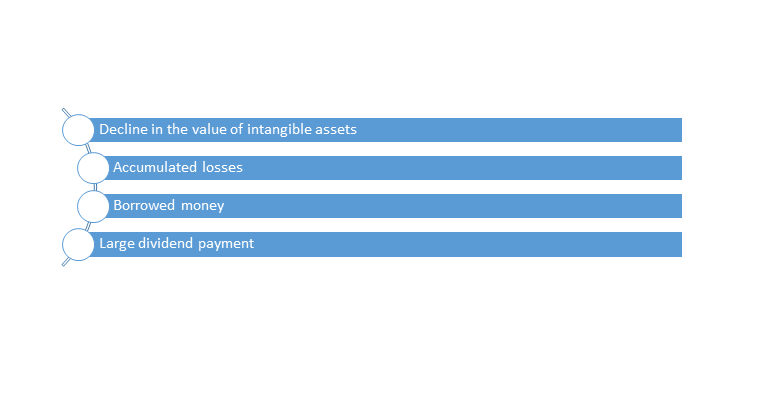
The following are the 4 main reasons for negative equity:
Negative equity due to the decline in the value of the intangible assets:
- Intangible assets are the ones such as copyrights, patents, trademarks, or any other such intellectual property.
- One of the main reasons for the negative equity of the company is the decline in the value of such intangible assets.
- There is a decline in the value due to them becoming obsolete, either due to them becoming outdated or being entirely refuted by another intellectual property.
Negative equity due to accumulated losses
- When a company will face a loss over the subsequent quarters, then it is called an accumulated loss.
- Accumulated loss can be mitigated by the profit that is generated by the company in those quarters as well as its pre-existing assets.
- Thus, it cannot be inherently considered a bad thing.
- But when the accumulated loss is greater than what can be safely covered by the assets of the company, then the company is said to have negative equity.
Negative equity due to borrowed money
- Taking out a loan or borrowing money from someone and not being able to pay back the full amount in time is a common story nowadays.
- It becomes true in the case of the companies as well.
- When the company as an entity will take a loan from a bank or borrow money from any other source but then is unable to repay the money due to a lack of profits or any other unexpected financial problems, then the company is said to have negative equity.
- It is to be noted that the companies that are being unable to return their borrowed assets could be a sign of fraud in the stock market as well.
Negative equity due to large dividend payment
- A dividend is the interest on the securities that are bought by the investors, which the company will pay when the traders sell their securities back to the company itself.
- An increase in liabilities will occur when these dividends are greater than the assets of the company.
- Thus, it is also important for any publicly listed corporation on the Indian stock market to keep their dividends balanced with their projected profits.
How does the negative equity affect the investors?
- In simple terms, it will result in the traders losing their money on their trades.
- They may end up not receiving any dividends should the company liquidate the entirety of its assets as well.
- Negative equity will affect the traders that are engaged in the short-term trades such as intraday trading and swing trading.
- Therefore, it is highly advised that the investors should thoroughly examine the balance sheets of the company for several quarters before trading in their securities to prevent losses on their trades.
- However, negative equity will not always mean that the company has liabilities due to unsound business decisions.
- Sometimes, a company may borrow the funds or use the majority of their assets in order to improve their existing infrastructure, which in turn will lead to profit in the future.
- This will usually happen in the case of start-ups.
Conclusion
This will make it clear that it is very important to do thorough research before trading.
Frequently Asked Questions (FAQs)
Q1) How does equity become negative?
Negative equity is when a company will owe more money to the investors than its assets can cover.
Q2) Why does McDonald’s have negative equity?
Negative equity in McDonald’s is due to share buyback.
Q3) Why does Starbucks have negative equity?
Negative equity in Starbucks is because its liabilities have exceeded its assets.
Q4) How do you end up with negative equity?
Negative equity will happen if you don’t put enough money down.
Q5) Is negative equity bad for the company?
A company with a negative equity balance sheet will owe more than it has on hand.
About Us
Nifty Trading Academy is our academy where we teach you about the stock market as well as technical analysis. We also provide live trading sessions and upload blogs for the same.